
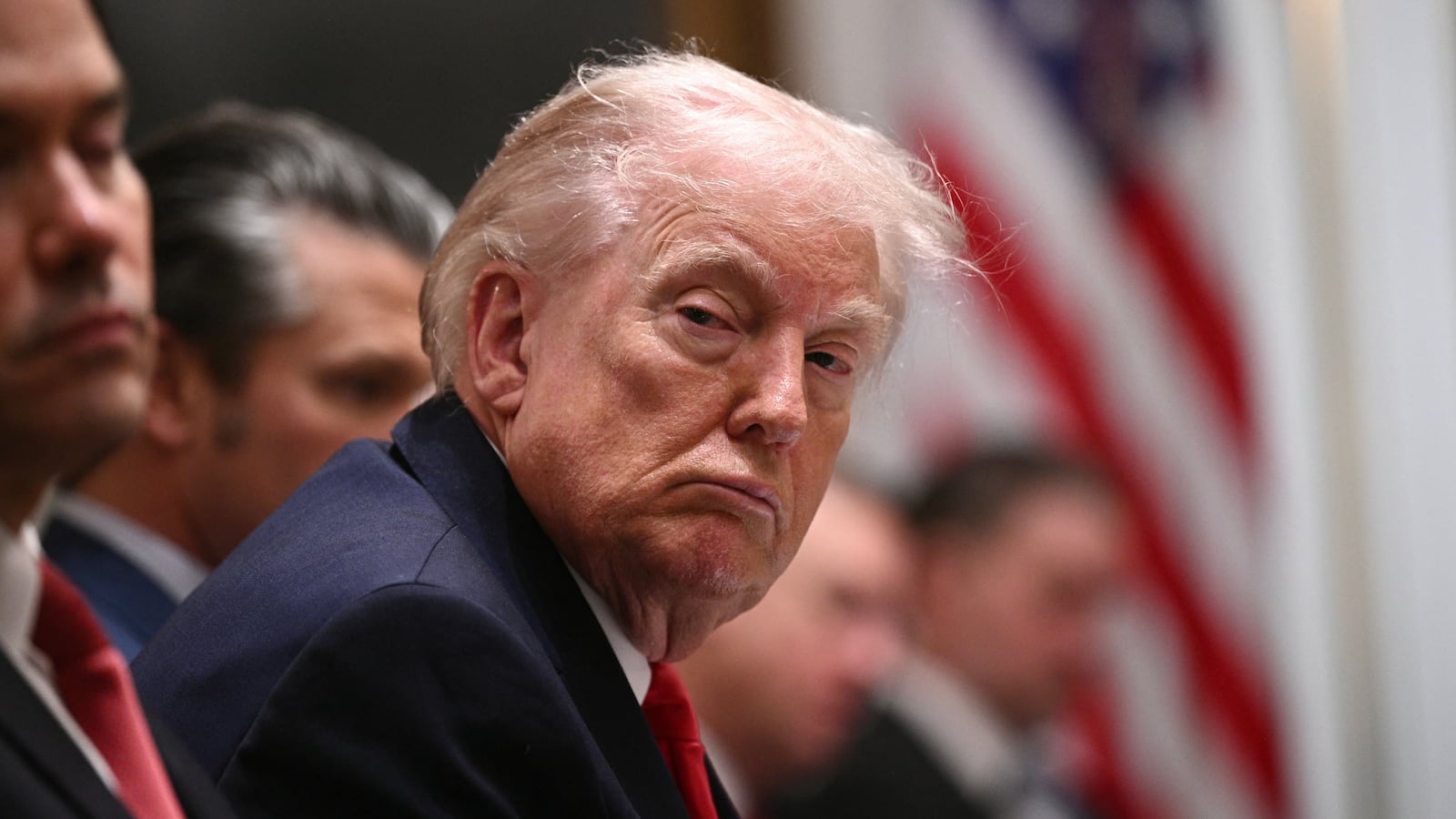
Donald Trump’s fresh attempt to fix his Strait of Hormuz quagmire has immediately suffered a blow.
The 79-year-old president on Sunday painted himself as a peacemaker as he announced a “humanitarian gesture” to guide stranded ships out of the narrow waterway that the U.S. has blockaded as leverage over Iran.
He said the plan, dubbed “Project Freedom,” would begin on Monday morning Middle East time. Tehran, however, responded resoundingly with a strongly worded statement warning that it would strike any U.S. ship that attempted to approach.

That warning landed before reports of a skirmish. Iran’s semi-official Fars news agency reported on Monday morning that a U.S. vessel was hit by two missiles near the port of Jask, at the southern entrance to the channel.
The “American-Zionist” vessels were blocked with a “swift and decisive warning,” according to Iran’s navy, via Reuters. However, a U.S. official denied the report, according to Barak Ravid of Axios.
“We warn that any foreign armed force, especially the aggressive U.S. army, will be attacked if they attempt to approach and enter the Strait of Hormuz,” the Iranian military said in a statement released earlier on Monday morning.
It said the security of the waterway “is in the hands of the armed forces of the Islamic Republic of Iran” and warned that “any safe passage and navigation in any situation” should be “carried out in coordination with the armed forces.”
“We will maintain and manage the security of the Strait of Hormuz with all our might and we announce to all commercial ships and tankers to refrain from any action to transit without the coordination of the armed forces stationed in the Strait of Hormuz so that their security is not jeopardized,” the military said.
U.S. Central Command said it would back the effort with 15,000 troops, more than 100 aircraft operating on land and at sea, and warships and drones.
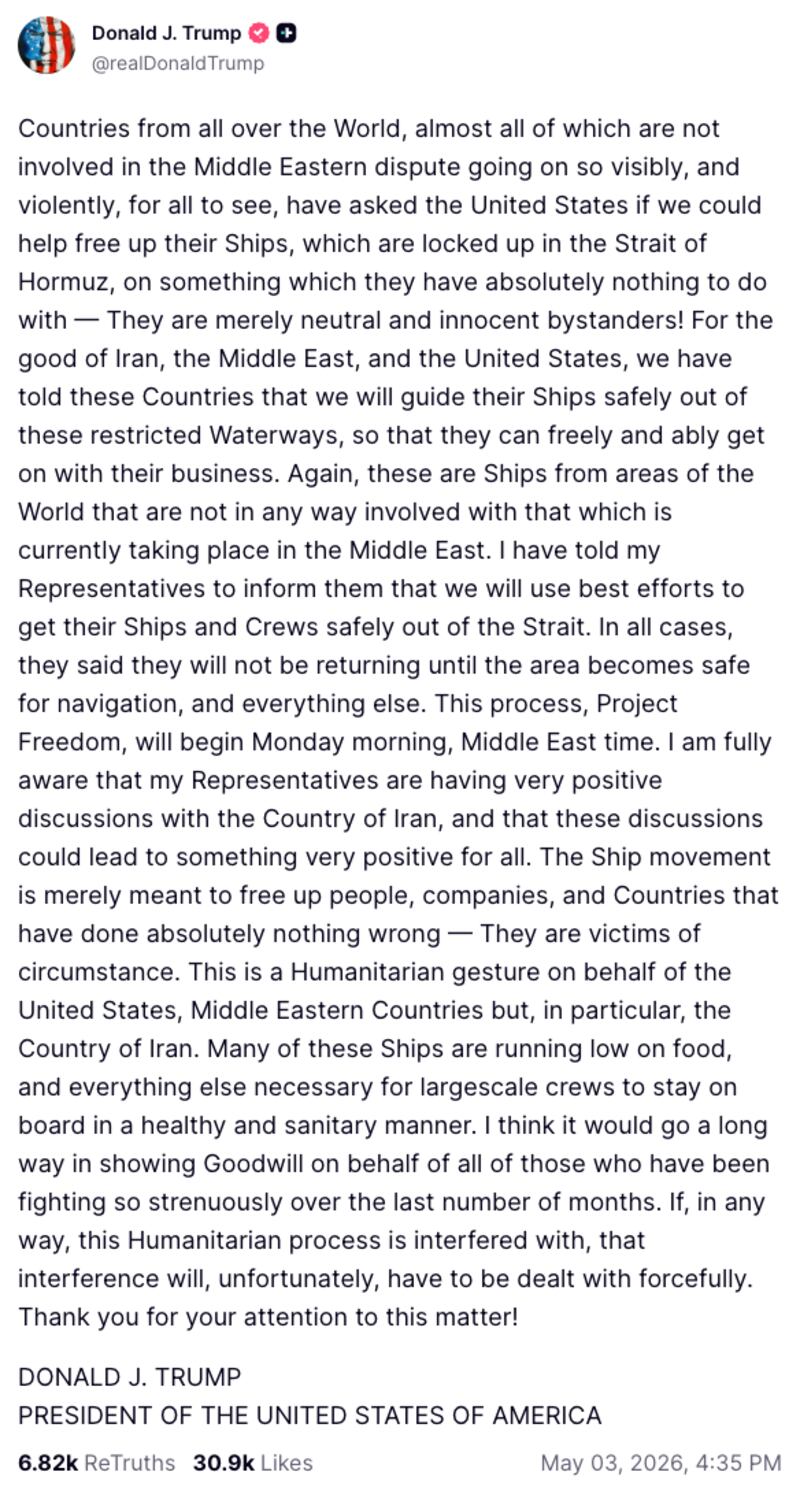
However, The Wall Street Journal, CNN, and Axios have emphasized Trump’s choice of the word “guide” rather than “escort” in explaining how the operation would be carried out.
U.S. officials contradicted the president in statements given to the WSJ. They said the plan “doesn’t currently involve U.S. Navy warships escorting vessels through the strait.” It is “not an escort mission,” one official told CNN.
U.S. ships will merely be located “in the vicinity” to oversee tankers moving through the strait, Axios was told.
Not long before Iran’s statement, Harlan Ullman, the chairman of the Killowen Group and a former senior U.S. naval officer, warned about what might happen if the regime didn’t play ball.
“If you think six months forward and we have denied the world 20 percent of its energy exports, huge amounts of its phosphorus essential for fertilizer, we could have a global economic catastrophe.”
Using AI modeling, he said the world could lose up to $6 trillion in trade, with the price of gasoline potentially reaching “$7 or $8 a gallon in the United States.”
“It would be chaos,” he added.
The Department of Defense and the White House were contacted for a response to Iran’s statement. The Pentagon referred the Beast to a statement from Sunday, where CENTCOM commander Adm. Brad Cooper announced the force would back Trump’s plans.
“Our support for this defensive mission is essential to regional security and the global economy as we also maintain the naval blockade,” he said.
The White House also referred the Beast to a statement from CENTCOM, which claimed that news of the strike on a U.S. vessel was fake.


