
Supergirl has always been a product of tokenism—a character designed to give girls what boys already have rather than an original creation like Wonder Woman.
Unsurprisingly, then, Supergirl, the character’s first big-screen outing since 1984’s feature, is merely a formulaic stab at adding diversity to the new DC Universe. In some ways, it’s superior to last year’s franchise-starter Superman, but its lack of originality or grandeur renders it a less-than-super spin-off.
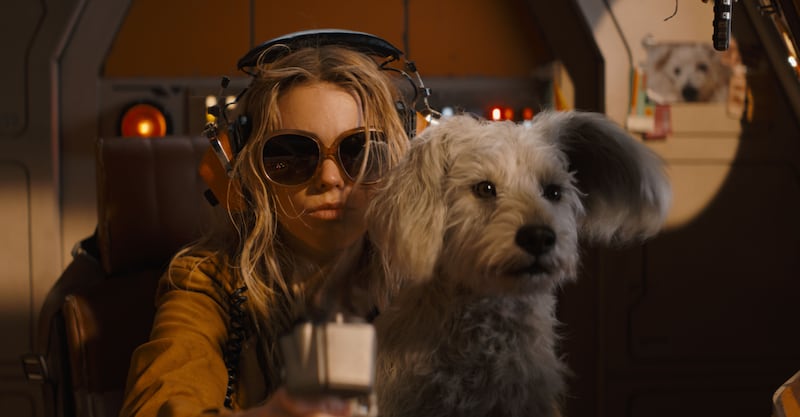
Directed by Craig Gillespie (I, Tonya, Cruella) and written by Ana Nogueira, Supergirl (June 26) has Superman director—and DC Studios co-CEO—James Gunn’s fingerprints all over it, most notably in its resemblance to his Guardians of the Galaxy trilogy, with which it shares a brash, off-the-cuff faux-subversiveness. Unlike her do-gooder cousin Superman, who views Earth as his home and is dedicated to truth, justice, and the American way, Kara (Milly Alcock) is a bitter and angry Kryptonian who, for her 23rd birthday, is gallivanting around the universe making pit stops at whatever watering hole she can find with her beloved pooch Krypto, whose cuteness has, alas, worn off.
Wearing a Blondie t-shirt and a long red overcoat, Kara wakes each morning on a spaceship couch with her sunglasses askew, hungover from the previous night’s escapades on planets whose red suns sap her of her powers and, thus, allow her to get hammered. Grouchy and off-putting, she’s a mess and uninterested in righting her dissolute course.
As flashbacks will eventually elucidate, Kara’s drunken flight from responsibility stems from her grief over the death of her parents in the aftermath of Krypton’s destruction. Yet her jaded sarcasm and who-cares cynicism are a familiar pose. And try as she might, Alcock affects it without much distinctive personality.
Supergirl has a cliché at its center, and derivativeness plagues its opening action, in which Kara visits cantinas filled with aliens straight out of Star Wars and gets into a scuffle with an E.T. bully who’s stolen Ruthye’s (Eve Ridley) father’s sword—the first of many fights in which Kara is vulnerable (if still triumphant) thanks to screenwriting contrivances.
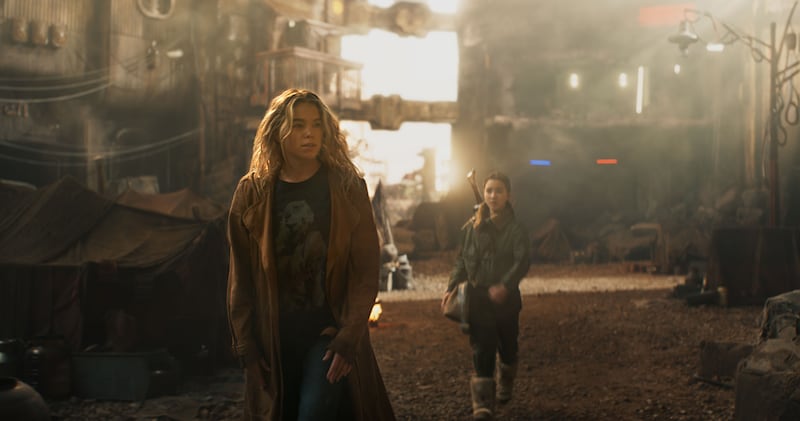
Ruthye is in search of Krem of the Yellow Hills (Matthias Schoenaerts), the leader of a group of pirates known as Brigands who slaughtered her family after procuring her dad’s legendary steel blades. Despite having no interest in involving herself in others’ business, Kara is soon roped into aiding Ruthye after Krem poisons Krypto and steals her ship with the antidote in tow.
As she tells Ruthye, revenge is wrong, thereby allowing the film to underscore, on multiple occasions, that Kara may not be nice but she’s inherently “good.” Gillespie’s tale largely hews to that notion as Kara hopscotches between worlds, trying to track down the baddie, whose face is covered in decorative studs and who taunts, menaces, and murders like the most stock villain in comic book history. He’s as pedestrian as Kara’s plight and emblematic of a quest that plays it safe at every turn.
Whereas Superman was an overcrowded affair that failed to maintain focus on its main character, Supergirl has no such attention deficit disorder, and when coupled with its concise dramatization of its heroine’s origin story, it feels more coherent. That consistency extends to its revelation that Krem and his Brigands are kidnapping young women and forcing them to be their brides—a sexual-slavery angle that adds to the proceedings’ feminism, which is as unaffected as its mild punk-rock attitude (complete with a female cover of Jimmy Eat World’s “The Middle”).
There’s nothing scattershot or tossed off about Gillespie’s latest, and save for a few instances of janky CG, its aesthetics are an appropriate mix of the cartoony and the grimdark.
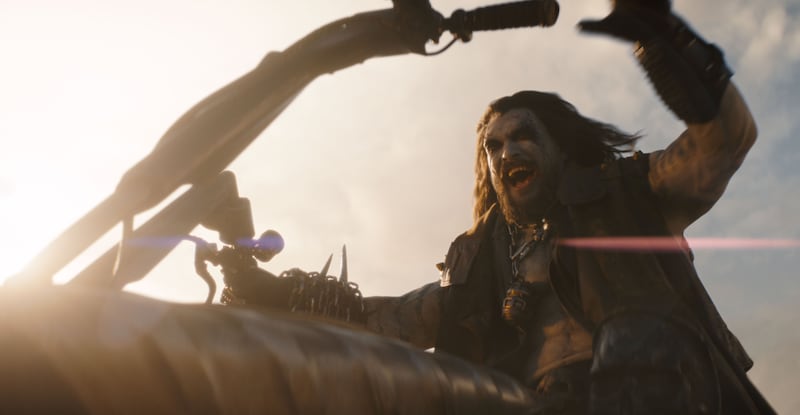
Speaking of which, Kara repeatedly crosses paths in Supergirl with Lobo (Jason Momoa), a wild-haired, cigar-smoking, motorcycle-riding immortal bounty hunter who has his own score to settle with the Brigands. Momoa grins maniacally, talks tough, and struts with outsized macho malevolence as the popular DC character, and his cutthroat misanthropic selfishness is a natural foil for Kara’s struggle to stay on the straight and narrow and uphold the virtues championed by her late parents and Superman.
From the moment he steps on screen, Momoa strains for larger-than-life badassery, and the effort is visible. Nonetheless, he’s a welcome presence in an undertaking that’s otherwise lacking individuality.
Because its protagonist is basically invincible, Supergirl works hard to create scenarios in which she isn’t, and the effect is that she rarely gets to prove her mettle. Even when that happens, it’s rather underwhelming, as Gillespie’s climactic wannabe showstopper—his camera rotating about in a slow-motion single take—is too studied and artificial-looking to make an impact. Before that, Kara spends the majority of her time nursing headaches, acting wobbly, and puking, all of which is supposed to make her an unconventionally relatable superhero, and yet comes across as forced.
Supergirl’s narrative revolves around Ruthye, a generic and uninteresting plot device conceived to provide Kara with a moral dilemma and to facilitate her predetermined change of heart, and though the material hints at lingering dark undercurrents, the entire endeavor is too thin to sustain any real sense of danger or complication. Gillespie avoids unnecessarily gussying up the film with excessive flourishes, and the soundtrack’s pop-rock cuts are seldom intrusive. Still, there’s little genuine sweep or swagger to this adventure, nor any meaningful stakes, as becomes clear during a final battle in which the only thing up for grabs is whether a random nobody will listen to the title character.
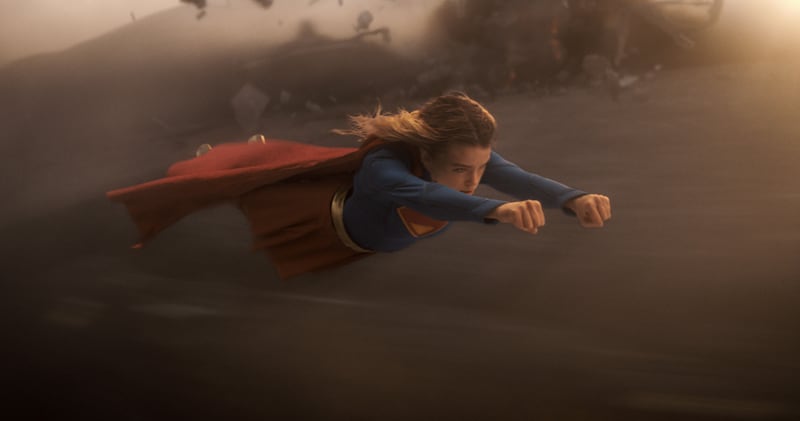
Supergirl continues DC’s transformation of its movie universe in overtly comic-book-y terms. And while that’s not an inherently bad thing, it’s so far resulted in more commotion than substance. Less a crash-and-burn flameout than a diverting intergalactic romp, Gillespie’s film is ultimately hampered by inconsequentiality, thereby undercutting its promise of future team-ups between Supergirl and Superman.
More clear-sighted but less bold than its franchise predecessor, it’s passable summer popcorn entertainment that, beneath its flashy spectacle and cheeky posturing, resembles simply another case of unimaginative IP management.