

While actors are always trying to be directors, Kristen Stewart demonstrates that she most certainly is one with The Chronology of Water, a blistering biography of a traumatized woman at war with herself and the world.
Pushing affectations to their breaking point as a means of immersing viewers in her protagonist’s fractured headspace, Stewart crafts an uncompromising and bracing first-person vision of suffering and humiliation, depression and degradation, violence and desire, and oppression and liberation. With star Imogen Poots vividly capturing the roiling contradictions born from her character’s crises, it’s a raw, rugged wound of a film.
Based on Lidia Yuknavitch’s 2011 memoir of the same name, The Chronology of Water (December 5, in theaters) opens with a sound-and-image flurry that defines its associative form.
Its action framed to resemble a home movie, the film introduces Lidia (Poots) on her hands and knees in a shower, where blood runs along with water into a drain. Sights of rocks, baby clothes, underwater letters, and hands in cars commingle with Lidia’s whispered narration about memories and stories.

Those prove to be one and the same for the young woman, whose recollections frequently involve her father Mike (Michael Epp), a tall, domineering man in glasses and neatly tucked in shirts who’s at the center of cacophony that also includes crying, notebook scribbling, children being forced into stained-wallpaper corners, and smacking sounds followed by yelps that appear to be one of the reasons young Lidia’s (Anna Wittowsky) teen sister Claudia (Marlena Sniega) leaves home and never looks back.
The Chronology of Water is a collage of pain, joy, longing, fear, and anguish, all of it tethered together by recurring motifs, the most common of which is water and Lidia swimming laps in a pool. Her aquatic talents, alas, only net her partial university scholarships, which isn’t good enough for Mike, an architect who appears to have an invisible hand permanently on the back of his wife Dorothy’s (Susannah Flood) neck.

Stewart and cinematographer Corey C. Waters’ camera movements and Olivia Neergaard-Holm’s edits are urgent, anxious, and unnerving. They echo Lidia’s condition as she clumsily navigates a life where caresses on the arm and smacks on the backside are commonplace, and where her sexual urges—expressed in secret behind closed doors, with boys in public, and in her imagination when it comes to the female teammates with whom she showers—commingle with thoughts of her tyrannical dad.
The Chronology of Water conveys everything through oblique glances and suggestive dialogue and voiceover, and yet it’s never unclear; Stewart’s mise-en-scène is assuredly disjointed, imparting Lidia’s feelings and circumstances via a swirl of threaded recollections. An opportunity to attend Texas Tech affords Lidia a second chance at swimming glory, albeit not before rapist Mike can scar her further.

Fury gives way to sexual discovery and, then, to a meeting with Phillip (Earl Cave), a sensitive singer-songwriter who’s destined to become the first of her husbands. Before their nuptials, however, rampant drinking and drugging earns Lidia expulsion from school, an overdose, and a spot at a substance abuse support group.
The Chronology of Water eventually settles into a somewhat more straightforward groove, but it remains a fragmented snapshot of Lidia’s roiling interior and exterior life. Amidst numerous hardships that amplify her downward spiral, she enrolls at the University of Oregon, where she joins a writing class taught by One Flew Over the Cuckoo’s Nest author Ken Kesey (James Belushi), who plans to collaborate with his students on a novel that will become Caverns.

Wearing a red beret in class, and a top hat and matching suit and cane on stage, Kesey—embodied by Belushi with equal measures of carnivalesque flair, conviction, and heart—is a flamboyant counterculture mentor to Lidia, in whom he believes. She’s similarly supported by her sister Claudia (Thora Birch), especially once she becomes pregnant with Phillip’s child and decides that she can’t stand her spouse, whose niceness and passivity are anathema to her raging-against-everything disposition.
On and on The Chronology of Water goes, with stillborn deaths, sexual assaults, lesbian trysts, and additional combative and supportive heterosexual relationships—such as with Tom Sturridge’s rowdy Devin and Kim Gordon’s BDSM-madame photographer —peppering Lidia’s path as she struggles to find a way to wrestle her demons into submission.
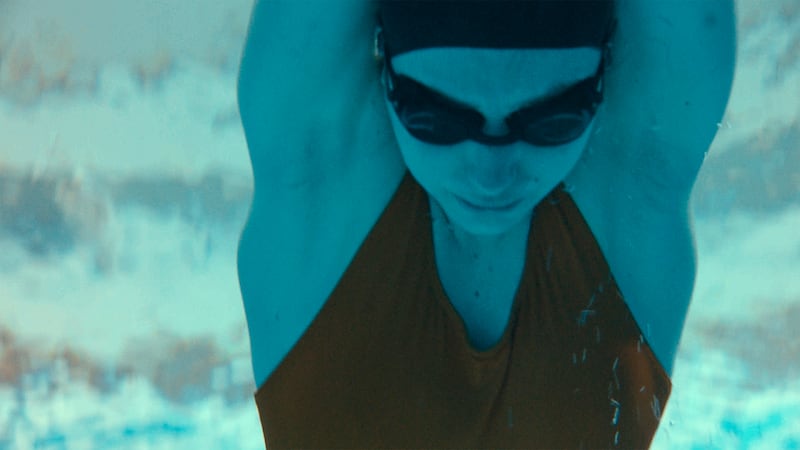
Battered, bruised, and brimming with vehemence and desperation, Poots makes Lidia a magnetically miserable figure on the brink of self-annihilation, all without losing a sense of the hope contained within her ferocity.
Incessantly bleeding, spitting, puking, and emitting other bodily fluids, she’s a whirlwind of hurt, and the actress never stoops to courting sympathy for her imprudent impulses and unwise decisions; on the contrary, she fully inhabits Lidia in all her messy, damaged glory as she moves—angrily, drunkenly, recklessly—from one pitfall-laden incident to another.

Stewart conflates Lidia’s past and present by cutting from the end of one scene to the beginning of another, and then back again (twice)—a formal device that’s in tune with her montage-y stream-of-consciousness structure. The Chronology of Water can be an exhausting up-close-and-personal study of feminine confusion and agony. Nonetheless, Stewart’s grasp of her material is strong and her compassion for Lidia is palpable, no matter the madness she indulges.
It’s only late that Lidia finds her way courtesy of a university teaching gig and a meeting with student Andy (Charlie Carrick), whose quiet and poised demeanor further bolsters her growing confidence and, ultimately, allows her to untangle the figurative knots tying her down.

The Chronology of Water is occasionally too showy for its own good, and its splintered storytelling—embellished by sporadic soundtrack screeching and strident strings—can be a tad wearisome. Still, it’s an impressive maiden behind-the-camera feature for Stewart, who exhibits a clear and distinctive aesthetic and narrative voice, and who maintains meticulous focus throughout on Poots, whose performance is as tender and inflamed as the film as a whole.
Intermittent pretentiousness be damned, they turn Lidia’s tale into a harrowing and heartening celebration of weathering storms in order to reach the calm.