The Knives Out movies love a good old-fashioned murder mystery trope.
Think of the real/fake weapon switcheroo in the first film, or the doppelgangers and fake death sequence in its sequel, Glass Onion. In Wake Up Dead Man, writer-director Rian Johnson’s third franchise installment, he evokes another thrilling trope—that of the informant on the other end of the line who’s killed before she can deliver crucial information—only to craft one of the best scenes of the year by subverting it.
(Warning: Spoilers ahead.)
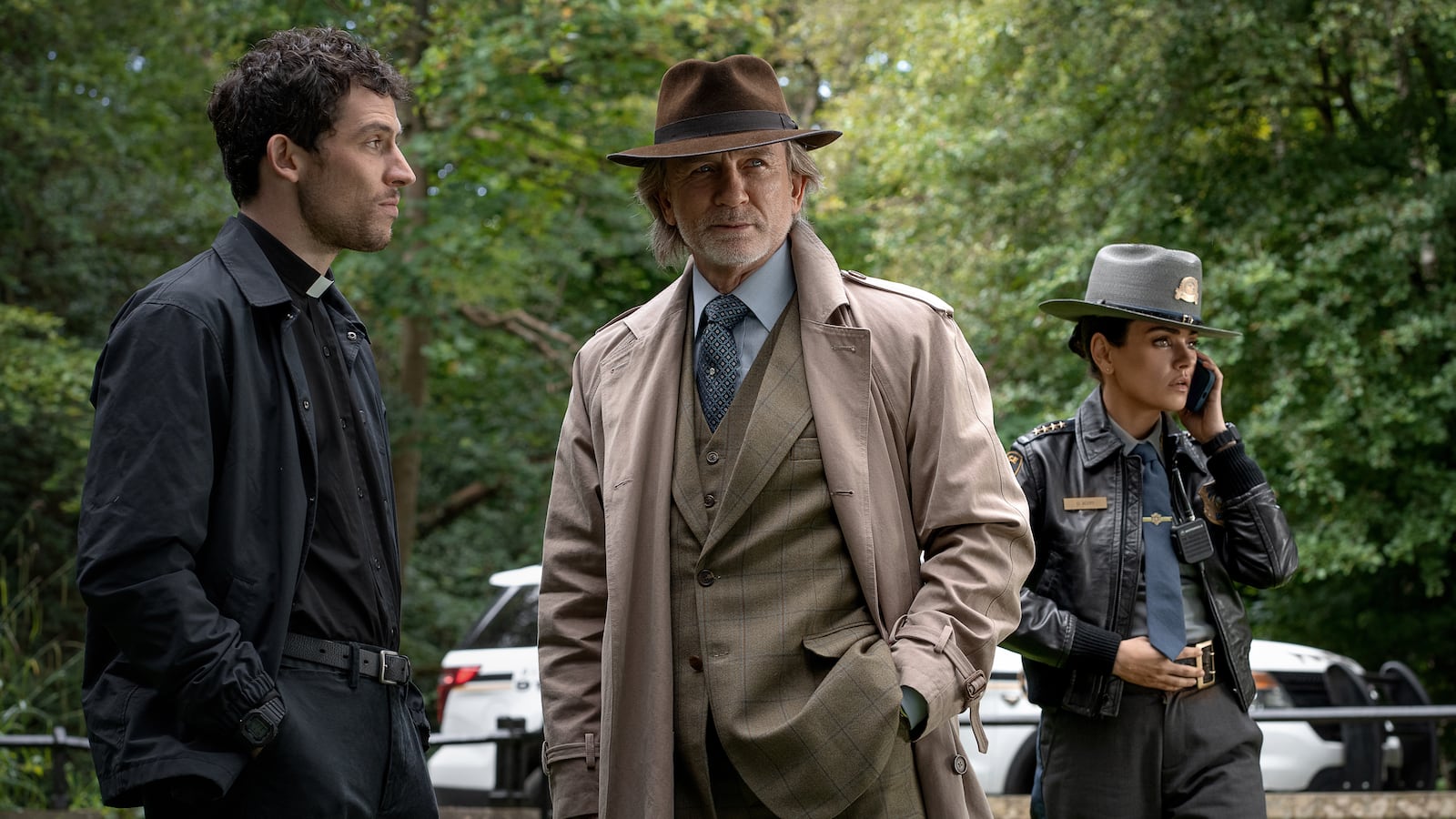
When detective Benoit Blanc (Daniel Craig) and Reverend Jud Duplenticy (Josh O’Connor) discover that a forklift used to open the local church’s crypt was ordered before Monsignor Jefferson Wicks (Josh Brolin) was killed, they deduce that someone must have anticipated his death (and thus the necessity of a final resting site). The obvious next move is to call the construction company and find out who placed that order—that’s their likely killer.
Co-owner Louise (Bridget Everett) answers, only to ramble on, first about the business, then while offering her condolences to Fr. Jud, who’s less bothered about the venomous monsignor being murdered than he is to find out who killed him. His urgent tone is in stark contrast to Louise’s easygoing stream of chit-chat. For Fr. Jud to get a word in, he must literally say, “I have to interrupt.”

Benoit is not so polite, bouncing up and down in frustration, taking deep, exasperated breaths and rolling his eyes. Even the camera seems impatient as he paces around the room, tracking each restless tic. Louise eventually reveals that her brother was the one who took the order, but he’s left for the day. She won’t give Benoit and Fr. Jud his number—much to their, and our, mounting annoyance—but instead offers to go the roundabout route of calling him, and then getting back to them.
By keeping the answer to the potential killer’s identity just out of reach, the scene builds and builds tension, eventually making Louise’s chatter unbearable. Just get to the point!, you might find yourself thinking. Even worse, however, is when the line goes dead silent.
The immediate assumption is that the talky Louise has become yet more collateral damage in the killer’s attempt to cover their tracks, stopped before she could spill their secret. What follows, however, is the film’s most poignant scene.
She haltingly asks Fr. Jud if he’d pray for her, the previous long stretch of silence now recontextualized as her having taken the time to weigh this request. Louise’s mother is terminally ill; the last words they spoke to each other were harsh, and there might not be a chance to set things right.

Everett and O’Connor’s quiet performances shift the previously snappy scene into wrenchingly sincere territory. As Louise breaks down, Fr. Jud reassures her that she’s not alone, moving to another room and shutting the door to not only give her privacy but also give the conversation the full scope of his attention.
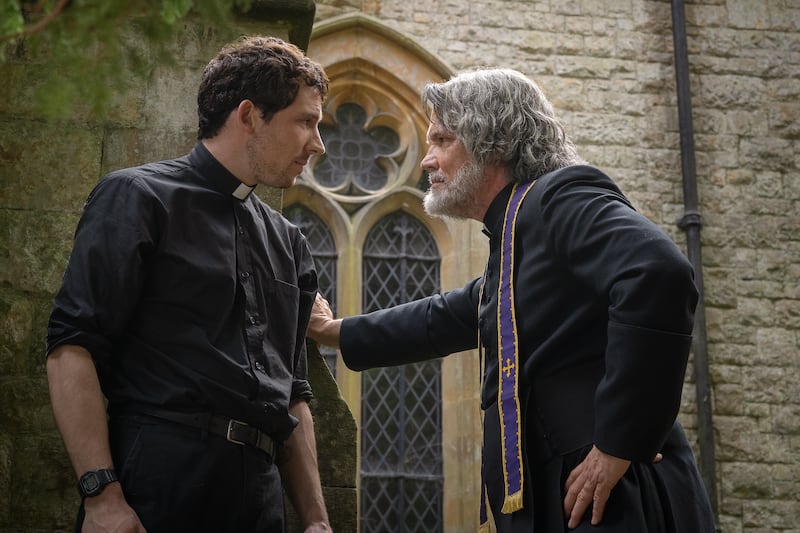
When Benoit first met Fr. Jud, he was accused of the monsignor’s murder. Distraught, he feared losing his role as a priest and his life’s purpose. “I don’t know how I’ll live,” he’d admitted, as though on the other side of the confessional. Now, in fulfilling his priestly duty by consoling Louise, he regains his purpose.
While the monsignor’s approach to his congregation was to rile them up with his fire-and-brimstone speeches, weaponizing their shame to humiliate them, Fr. Jud listens without judgment. Where the monsignor radicalized and agitated, Fr. Jud comforts. Earlier, he’d watched a tiny Jesus figurine be smashed in front of him without flinching, disappointed that there wasn’t a Swiss bank account number stashed inside; now a shot of those same scattered pieces during the call serves to remind him how, in becoming swept up by the investigation, he’d lost sight of his duty. He now knows what he must do.
Johnson’s Knives Out movies are as much mystery movies as they are morality tales, as much about the revelation of the murderers’ identity as they are a reconfirmation of the protagonists’ innate goodness—recall Benoit in the first film staving off Marta’s (Ana de Armas) terror at potentially having mixed up crucial medications by reminding her that she’s a good nurse. By the end of that phone call, Fr. Jud doesn’t get the answer he wants, but the one he needs, resolving something much deeper within himself. He’s a good priest.