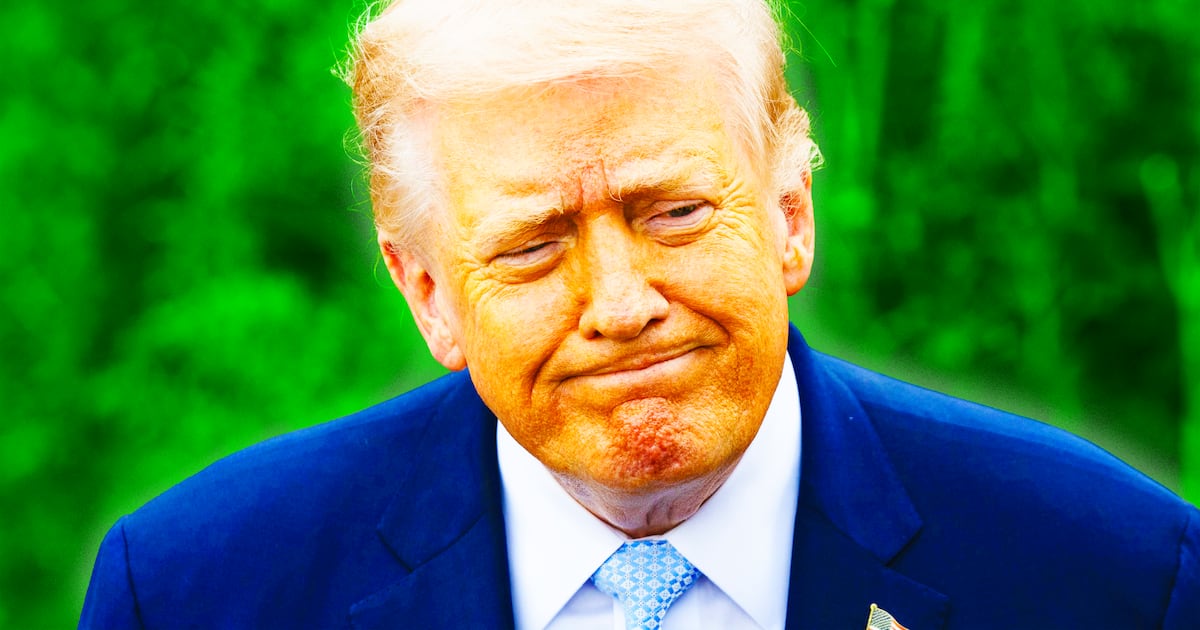
President Donald Trump has reversed course on his threats to “obliterate” Iran hours before his 48-hour deadline was due to expire.
On Saturday, the 79-year-old president said he would pummel the country if it didn’t agree to open the Strait of Hormuz, a strategically important shipping lane in the Gulf region, within 48 hours. The regime didn’t take the statement lying down, warning that it would “irreversibly” destroy critical infrastructure in neighboring countries.

Economic panic brewed over the weekend, with analysts warning of an all-out energy crisis. But by Monday morning, Trump suddenly had a very different tone, saying Washington and Tehran had engaged in talks that prompted him to take things down a notch.
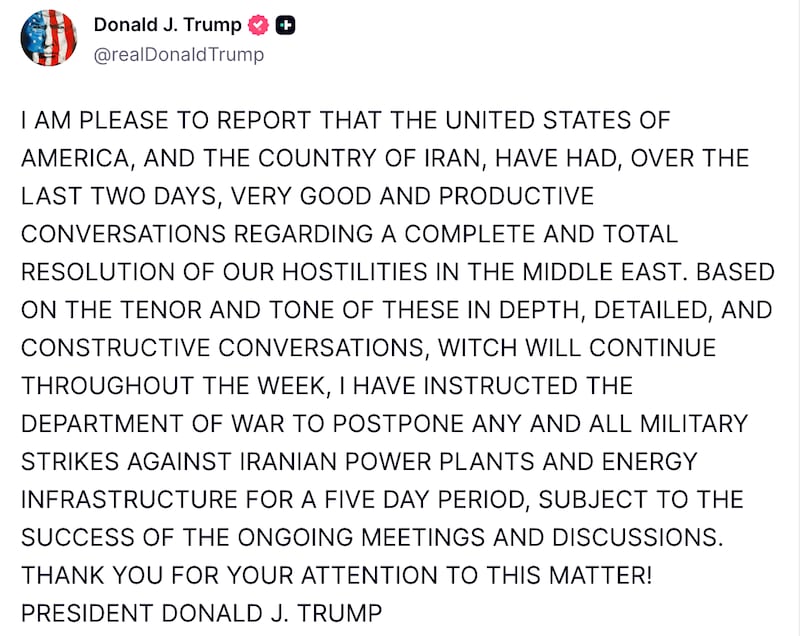
Writing in all caps, Trump said, “I AM PLEASE TO REPORT THAT THE UNITED STATES OF AMERICA, AND THE COUNTRY OF IRAN, HAVE HAD, OVER THE LAST TWO DAYS, VERY GOOD AND PRODUCTIVE CONVERSATIONS REGARDING A COMPLETE AND TOTAL RESOLUTION OF OUR HOSTILITIES IN THE MIDDLE EAST.”
Trump made a typo within his first few words, writing “PLEASE” instead of “PLEASED.” He also wrote “WITCH” instead of “WHICH.”
He continued: “BASED ON THE TENOR AND TONE OF THESE IN DEPTH, DETAILED, AND CONSTRUCTIVE CONVERSATIONS, WITCH WILL CONTINUE THROUGHOUT THE WEEK, I HAVE INSTRUCTED THE DEPARTMENT OF WAR TO POSTPONE ANY AND ALL MILITARY STRIKES AGAINST IRANIAN POWER PLANTS AND ENERGY INFRASTRUCTURE FOR A FIVE DAY PERIOD, SUBJECT TO THE SUCCESS OF THE ONGOING MEETINGS AND DISCUSSIONS.”
Minutes after the first post, it was deleted, and a new one appeared with the typos fixed.
Iran’s foreign ministry denied that any talks with the U.S. had taken place, telling state media that comments from “the U.S. president are part of efforts to reduce energy prices and buy time to implement his military plans,” according to the Associated Press.
The statement marks a stark removal from the tone of his initial threats and could be designed to give markets—and his administration—breathing room after a brutal week. The “five-day” period means that the pause neatly ends at the closing of the markets on Friday, giving Trump the weekend to regroup.
But while the markets might rally slightly, polling for Trump’s war is still in the gutter, according to two recent polls. A Reuters/Ipsos survey of 1,545 adults conducted March 17–19 found 59 percent disapprove of the conflict, with only 37 percent in support. An Economist/YouGov poll, conducted days earlier, told a similar story. It found that some 56 percent oppose the war and only 33 percent support it, with independent approval of Trump’s handling of Iran sliding from 30 percent to 24 percent in a single week.
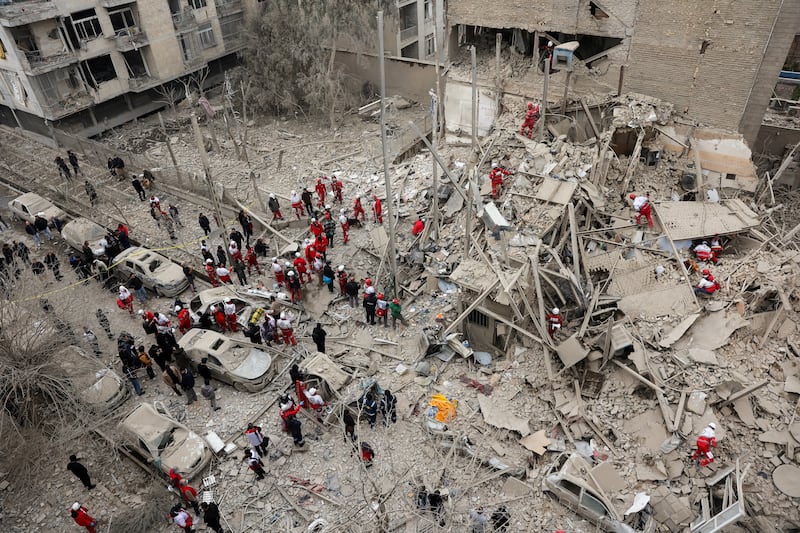
The president’s climbdown comes after the head of the International Energy Agency warned of a “major, major threat” to the global economy. “No country will be immune to the effects of this crisis if it continues to go in this direction,” Fatih Birol said at Australia’s National Press Club in Canberra.
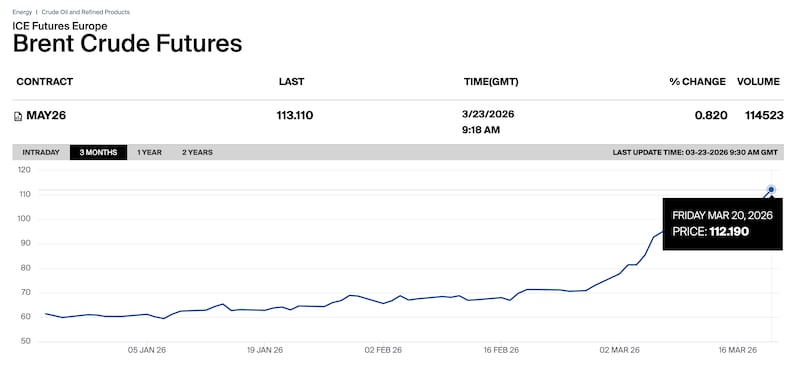
Indeed, the benchmark price of oil ticked up 1.5 percent to $114, European stocks entered correction territory and U.S. futures pointed to losses of around 1 percent on Wall Street. Gold fell more than 8 percent, according to Bloomberg, while the Financial Times said silver tumbled by 10 percent.
Rory Johnston, oil market researcher and founder of Commodity Context Corp, told Bloomberg that Trump had backed himself “into a corner” with his threat. “It is highly unlikely that Tehran will agree to Trump’s terms on such an accelerated timeline under the threat of attack. And Iran is clearly able and willing to match any escalation,” he said.
The White House referred the Beast to Trump’s remarks outside Air Force One as he prepared to board a flight in Palm Beach. He said the talks between D.C. and Tehran have been “very strong,” and that they had been led by his adviser Steve Witkoff and son-in-law Jared Kushner.
“We will see where they lead,” he said. “We have major point of agreement; I would say almost all points of agreement.”