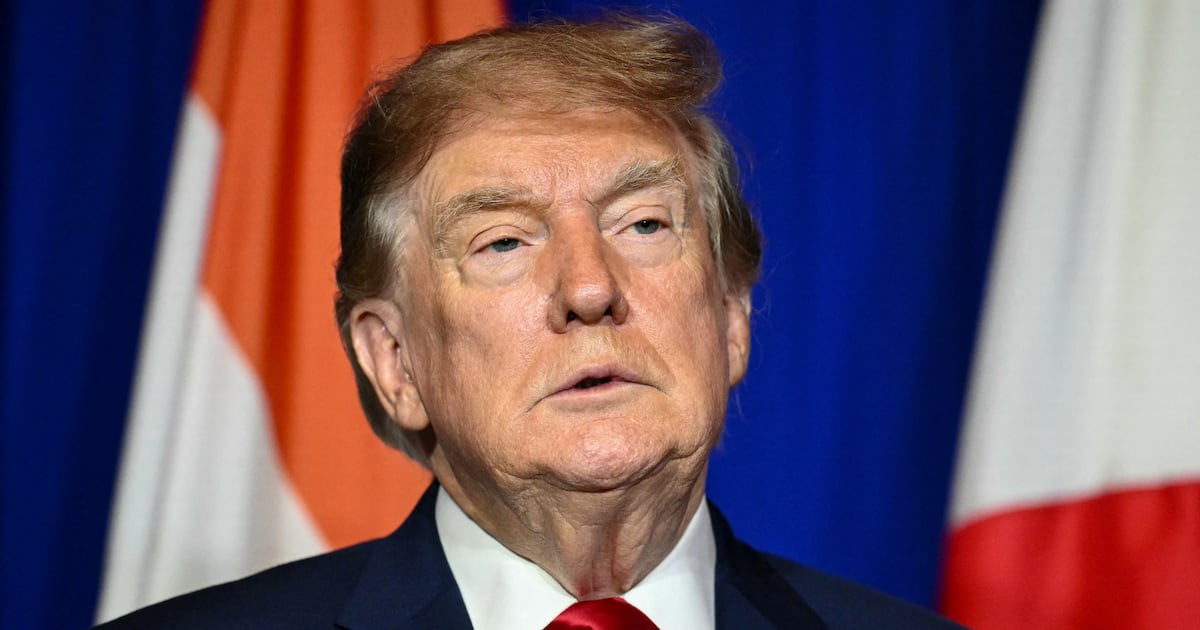

Donald Trump’s superpower summit in China had barely begun when Vladimir Putin made it clear how much the U.S. president was being played.
As Trump sat down with his Russian counterpart and Chinese president Xi Jinping to discuss a new pact for global stability, Moscow’s forces were continuing to bomb Ukraine, wounding civilians and damaging infrastructure across the region.
And as soon as the summit ended, Putin declared he would not negotiate a ceasefire with Ukraine and would continue to attack the sovereign nation with a “much more painful” response.

It was a humiliating outcome for Trump, who boasted ahead of his trilateral meeting that the U.S. and China both want the war in Ukraine to end and vowed that “wonderful things” would emerge by sitting down with Russia.
A beaming Trump even greeted Putin as his “friend” as the two arrived for a pull-aside meeting ahead of their three-way summit, in extraordinary scenes that reverberated around the world.

“Who is he? He’s my friend,” the 80-year-old declared as he walked into a room to embrace the Russian dictator.
“We’ve had a great relationship for many years,” Trump then told the media before the pair sat down for talks.

“We’ve known each other for a long time, and I think a lot of wonderful things can come out of this—or at least start. But I think they’ll come out of this.”
Instead, Putin walked away with the international legitimacy of sharing the stage with the American president and a joint statement lashing out at the International Criminal Court that has accused him of war crimes.
Meanwhile, Ukraine was left with no ceasefire, no concrete commitments, and no mention in the leaders’ joint declaration.

“God, protect us from such friends,” said Polish Prime Minister Donald Tusk.
The historic summit in China came as the Trump administration faces a series of domestic problems. These include public fears over a series of poorly explained outages; a national security scandal involving former Nvidia CEO Jensen Huang and an alleged Chinese spy; and the ongoing fallout of the midterm election wipeout.
The trip was therefore a chance for the president to project strength on the world stage, even as his authority is significantly diminished and he faces lame-duck status over the next two years with Democrats controlling Congress.

But for much of the visit, Trump appeared more like a star-struck guest, lavishing praise on the authoritarian leaders while congratulating himself on the historic spectacle of bringing them together.
The meeting had also been flagged as a chance to discuss nuclear safety, particularly in the context of Iran, despite the fact that both China and Russia are allies of the Iranian regime.
Sitting on an oversized, circular table, Trump said the three powers were “uniquely positioned” to reduce the number of nuclear weapons in the world.
Xi said the weapons should be “completely prohibited and thoroughly destroyed,” while Putin said in his opening statement that they had a “joint responsibility for maintaining international peace and security.”
But the summit itself yielded little in the way of obvious diplomatic breakthroughs, and the framework they agreed on did not place any limits on China’s fast-growing nuclear arsenal.

According to the leaders’ joint statement released by China’s state news agency, the men agreed only to discuss reducing risks and preventing proliferation.
Posting from the plane on his way back to Washington, Trump described the trip as “highly consequential.”
“Heading back to Washington, D.C., from China. It was a Great and Highly Consequential Trip. I will be giving a News Conference tomorrow at 12 P.M., the White House. Also, will be discussing the Trade Deals with Thailand, the Philippines, and others,” he wrote on Truth Social.
But extraordinary visit raised eyebrows among America’s allies, who have spent years trying to isolate Putin over his invasion of Ukraine.

Sweden’s EU minister Jessica Rosencrantz reiterated a principle that guided Washington before Trump returned to power: “There should be no talks about European security without Europe; there should be no talks about Ukraine without Ukraine.”
Back in the U.S., Senate Democratic leader Chuck Schumer was far more blunt.
“Xi Jinping and Vladimir Putin are playing Donald Trump like a cheap violin,” he said, accusing the two authoritarian leaders of exploiting the president’s appetite for flattery.