
Maybe the 10 directors on Nvidia’s board are among the few remaining people still impressed by a phone call from that lamest of lame ducks, President Donald Trump.
No doubt, they also wanted to make even more money, as they did when their unanimous vote to reinstate Jensen Huang as CEO sent the stock soaring 31.48 percent.

And Trump’s predictable claiming of credit for Huang’s return has left the board less open to charges that its members had sacrificed principles for principal. So what if they resurrected a philanderer whose multiple pals included an alleged Chinese spy who is said to have facilitated the smuggling of AI microchips?

Trump himself seemed as happy as ever to place an oligarch’s interests ahead of the nation’s. We should be thankful he does not have enough days in office to constitute a full Gilded Age. And we can hope the results of the midterm elections presage the advent of a new progressive era.
Just before America’s much-hyped 250th anniversary, Trump boarded a new Air Force One gifted to him by Qatar and flew in mega-oligarch style to the opening of the Theodore Roosevelt Presidential Library in Medora, North Dakota. Trump there encountered an AI-generated hologram of Roosevelt.
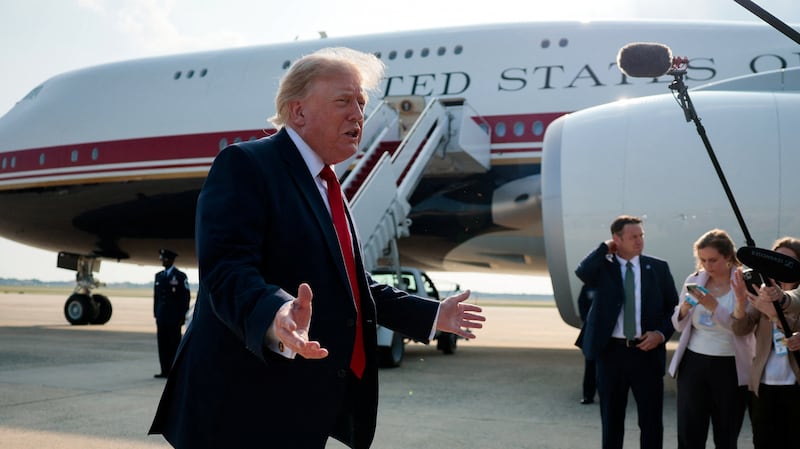
A younger Trump had conned his way through multiple bankruptcies via what he called The Art of the Deal. But now, in his second term as president, he was grifting his way into actual riches, channeling the profoundly corrupt ways of the robber barons of the Gilded Age. He was invited to pose a question to the digital Roosevelt. He responded as a former builder who had always believed bigger is better, to the point where he would tell people his eponymous tower is 68 stories when it is only 58.
“Do you consider the Panama Canal your greatest achievement?” Trump inquired.
“Right then, yes,” his digital predecessor replied.

“Good answer,” Trump said.
“The canal stands as one of my proudest battles, no question,” digital Roosevelt continued. “But greatness is a strange thing. It isn’t always the biggest or boldest job that matters most.”
The Roosevelt hologram then spoke as an actual president should.
“I measure my greatest work by the lives improved, parks set aside, food and drugs made safe, the square deal given to all, not just to a few.”

Among Theodore Roosevelt’s letters in the Library of Congress is one from July 1903, in which he wrote: “This administration stands for a square deal all around.”
He said in a January 1904 letter: “If there is one thing that I do desire to stand for it is for a square deal, for an attitude of kindly justice as between man and man, without regard to what any man’s creed or birthplace or social position may be, so long as, in his life and in his work, he shows the qualities that entitle him to the respect of his fellows.”

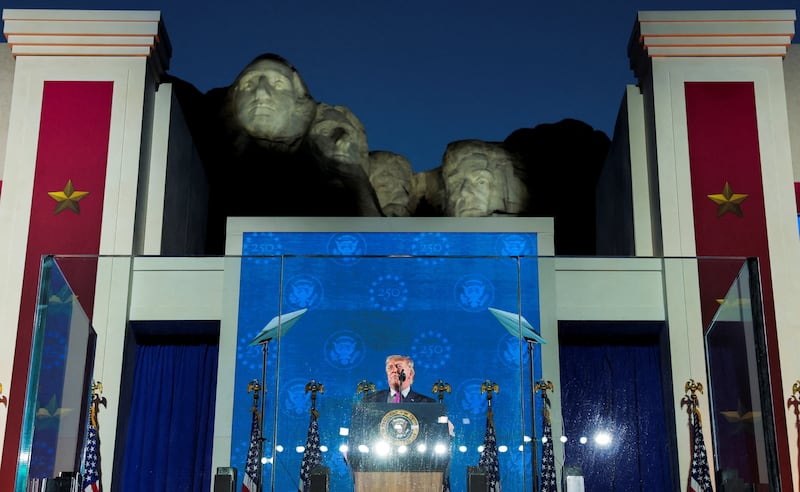
Two days after the Theodore Roosevelt Library event, Trump flew in his super-luxe airborne emolument to Mount Rushmore in South Dakota. Trump stood there before a stone version of Theodore Roosevelt, whose actual greatness merited him a place carved into the mountain along with George Washington, Thomas Jefferson and Abraham Lincoln.
However much money Trump grifts and however many oligarchs he abets, his place in history will be beside Vladimir Putin of Russia and Xi Jinping of China, who stand for whatever deal best serves themselves at whatever cost to others. He calls these dictators his friends and imagines he has their respect. They must laugh at the ease with which they flatter him into doing their bidding.
If Trump wanted a shot at greatness worthy of stone, he should have listened to that hologram about the qualities that entitle a person to respect.


