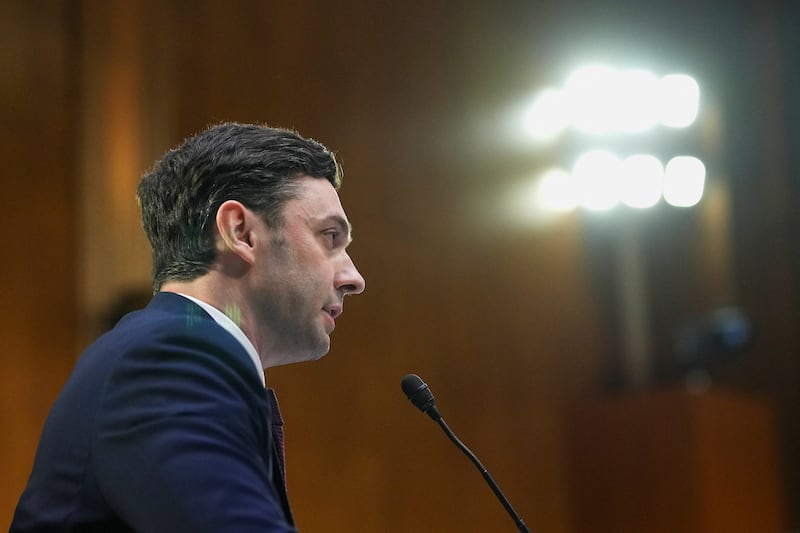
Pete Hegseth was left stumbling through his responses after Democratic Sen. Jon Ossoff used the defense secretary’s own words on the Iran war in a blistering grilling on Capitol Hill.
The Pentagon chief was appearing before the Senate Appropriations Committee on Tuesday, where the Georgia senator used his own bluster about how well the war was going against him.
It came as Hegseth estimated that the war has cost $37.5 billion to date, and with President Donald Trump signaling no end in sight to the war he started at the end of February.

“On day 14 of this conflict, Mr. Secretary, day 14, nearly five months ago, you stated that Iran’s military had been, ‘destroyed,’ and ‘made combat-ineffective.’ That was on day 14 of the war. Was that an accurate statement?” Ossoff asked.
Hegseth responded that they did not have a Navy any longer; it was “completely sunk” and “missiles were buried underneath a lot of their underground facilities and their defense industrial base has been almost completely destroyed.”
“So, as far as a military assessment of Iran’s capabilities, it didn’t mean by any stretch of the imagination absolute zero—” Hegseth said, but he was cut off.
“Mr. Secretary, you stated that on day 14 of this conflict, on the second week of the conflict, you stated that Iran’s military had been, ‘destroyed,’ and, ‘made combat-ineffective.’ Was that an accurate statement, yes or no?” Ossoff repeated.
Hegseth tried to talk about “Iran’s ability to challenge the United States of America at the level at which we’re capable of—” but he was again cut off.
“That’s not what I asked you, Mr. Secretary,” Ossoff said before repeating his question using Hegseth’s words for a third time.
“What the American military has done to the Iranian military—” Hegseth started after a pause.
“Will you answer the question?” Ossoff cut in.
As he spoke, Hegseth tried to keep going and declared it an “historic military defeat.”

Ossoff questioned whether he would answer his question under oath before moving on without receiving a direct response.
“Three weeks later you declared victory. That was now nearly four months ago. Three weeks after you had already said Iran’s military was destroyed and combat-ineffective, you said, ‘Operation Epic Fury was a historic and overwhelming victory.’ You said Iran’s military had been rendered, ‘combat-ineffective for years to come.’ And you stated we have, ‘achieved every single objective.’ Were those accurate statements?” Ossoff asked.
“It certainly was, on behalf of the men and women in uniform, a historic military victory over Iran,” Hegseth insisted.
“Had Iran’s military been rendered ‘combat-ineffective for years to come?’” Ossoff repeated.
“They had 160 naval vessels in their bluewater Navy, and they’re gone. Their air force is completely combat-ineffective, and they don’t have a defense industrial base,” Hegseth insisted.
His comments came just days after at least three U.S. service members were killed in Iranian attacks over the weekend.

Ossoff told Hegseth he needed to answer his questions, but Hegseth kept going, as he started to raise his voice.
“So describe for me a country that doesn’t have an air force, a navy or a defense industrial base, and I will describe for you a country that doesn’t have an effective military,” the Pentagon chief pushed back.
Ossoff tried to keep going with his questions, but Hegseth tried to speak over him. However, the senator was undeterred in his line of grilling.
“Mr. Secretary, you stated four months ago that Iran’s military had been rendered ‘combat-ineffective for years to come.’ Has Iran’s military been for the last four months combat-ineffective?” the senator asked.
“Set back not just years but likely decades considering it can’t build at the level it did before, not even close,” Hegseth declared.
“It doesn’t mean it doesn’t have capabilities,” he then admitted, folding.
“Mr. Secretary, you stated we had ‘achieved every single objective.’ Was that an accurate statement four months ago?” Ossoff fired back.
“The main objective of this was to ensure that Iran never gets a nuclear weapon. Their main sites were obliterated. We’re watching over them, and we’re holding that issue,” Hegseth said. “If they don’t give them up at the table, there are other ways we can take them away.”
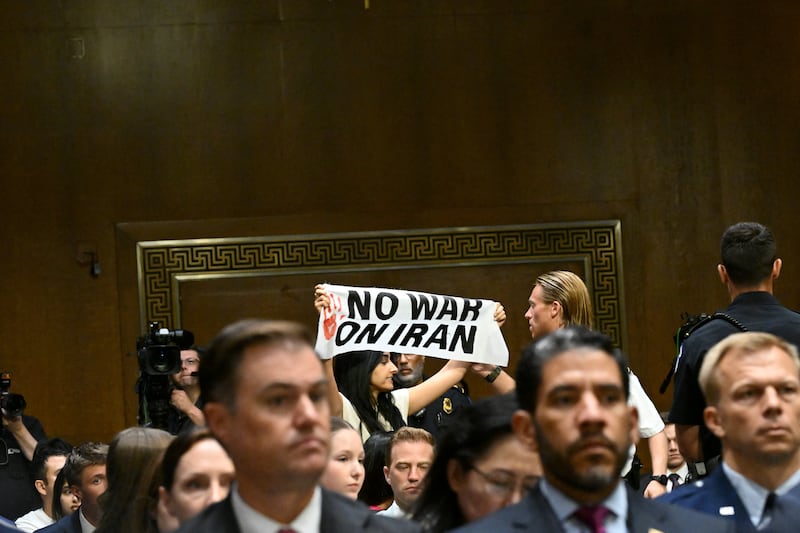
His comment appeared to acknowledge his previous statement had not been true at the time, but he did not openly admit it as he spoke quickly.
But Ossoff was not done throwing Hegseth’s own previous claims back in his face.
“Early in the conflict, day three, you said one of those core objectives was to ‘destroy the missile threat’ and as you restated on day five, to ‘obliterate Iran’s missiles and drones.’ Those were clearly and repeatedly stated core objectives of the campaign, which four months ago you had declared had been completed victoriously with every single objective achieved,” Ossoff said, cornering Hegseth. “Were those objectives achieved four months ago?”

“No one ever stated that every single missile was gone,” the defense secretary claimed. “Ultimately, combat-ineffective means they’re not able to dig them out of their UGFs and shoot at us. It doesn’t mean they don’t have underground facilities where they put missiles in them and hold onto them because they’re the world’s largest state sponsor of terrorism,” Hegseth stammered.
“We never expected they would stop having capabilities to shoot. The question is at scale against opponent like the United States of America, which... Iran couldn’t and cannot handle,” Hegseth added, singing a completely different tune from what he and the president had previously suggested.

Ossoff then brought up Hegseth’s assurance of “Iranian surrender” on March 8.
“Does that remain your prediction?” Ossoff asked.
“Ultimately Iran will never have a nuclear weapon to threaten the United States of America,” Hegseth declared. “That has been the objective, and it remains so.”
He did not address Ossoff’s surrender prediction.
Ossoff was not the only one who called out the administration’s claims and mixed messages as Hegseth went before Congress to ask for another $70 billion to fund the war.

“The words you have used in the past don’t add up,” Sen. Kirsten Gillibrand said while blasting the administration for asking for more money for “unlimited money for bombs” while not providing enough for Americans to afford healthcare and food.
Democratic Sen. Jack Reed also called out Hegseth’s “gross negligence” while grilling him on the closure of the Strait of Hormuz due to Trump’s war. Reed zeroed in on the near shutdown of shipping through the crucial waterway, which has driven up prices globally.
Hegseth insisted that when Trump started the war, the administration was well aware of the possibility of the Strait being closed, but when confronted over the ongoing issue, he tried to bring up his often-favored excuse of targeting the Biden administration.
“Obviously, sinking their ships has not affected their ability to effectively close the Strait,” Reed said.
“We had U.S. boats that surrendered to Iranian ships under the Biden administration,” Hegseth complained, but Reed was not having it.
“We are talking a war you started—not a situation in which oil was flowing freely, there was no conflict, we weren’t losing personnel as a result of Iranian action, so your fallback to the Biden administration is just a very, very obvious excuse of what I think is probably, as you describe it so often, gross negligence.”