With all due respect to Aaron Sorkin, filmmaker Luca Guadagnino has delivered the true sequel to The Social Network with Artificial, an A.I. origin story that’s at once a cautionary tale, horror show, and tragedy.
Detailing the rise, fall, and still-skyrocketing re-ascent of OpenAI and its CEO Sam Altman, the Call Me By Your Name auteur’s latest (world-premiering at the New York Film Festival ahead of its Dec. 25 theatrical release) is a saga of timely terror. If its tonal unevenness sometimes undercuts its urgency, it’s still an engrossing lament that we’re forever doomed to repeat our mistakes—until, that is, we’re literally doomed.
Amazon MGM Studios—run by the MAGA-friendly Jeff Bezos—tried to kill Artificial after it was completed (it’s now being distributed by NEON), and given its scathing depiction of its subject, it’s easy to assume that decision was driven by reasons that have nothing to do with the film’s quality. Whatever the case, Guadagnino’s drama doles out a figurative beating to OpenAI and Altman, whom Andrew Garfield embodies as the phoniest and most amoral of toxic tech bros.
Having suffered at the hands of a megalomaniac as Facebook co-founder Eduardo Saverin in The Social Network, the star now assumes the role of an agent of apocalyptic calamity, and his compellingly rancid performance is the dark heart of this modern fable. Even so, it’s Anora’s Yura Borisov who runs away with the film as the idealist whose dreams of a brighter tomorrow are shattered by the realities of an avaricious and cold-blooded today.
In 2003, math prodigy Ilya Sutskever (Borisov) arrives at the University of Toronto office of famed computer scientist Geoffrey Hinton (Mark Rylance)—who’ll decades later win the Nobel Prize and be known as the “godfather of A.I.”—and immediately wows him with his genius. Sutskever is convinced that artificial general intelligence (AGI) is a potential reality in his lifetime, and despite his peers’ mockery, his collaboration with Hinton earns them millions in funding from Google, where they strive to achieve what many deem “science fiction.”
For Sutskever, AGI heralds paradigm-altering breakthroughs in science, medicine, and other fields that will reap tremendous benefits for mankind. He’s a true believer, and his zealotry earns him a fan in Altman.
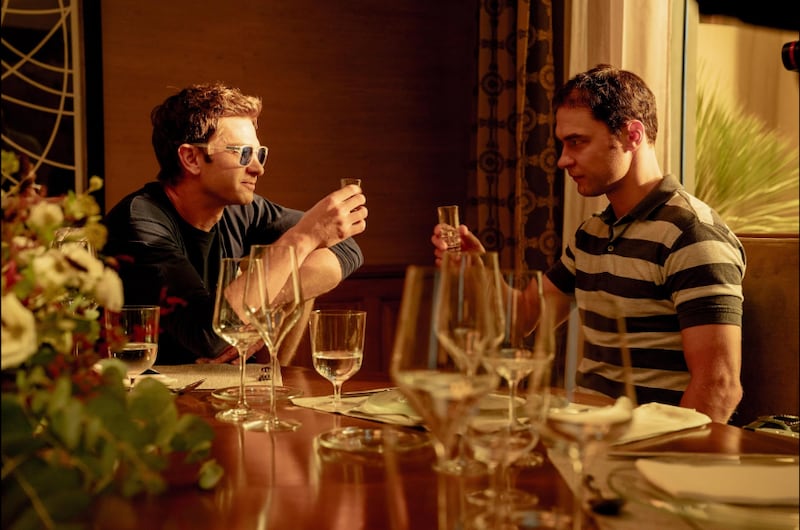
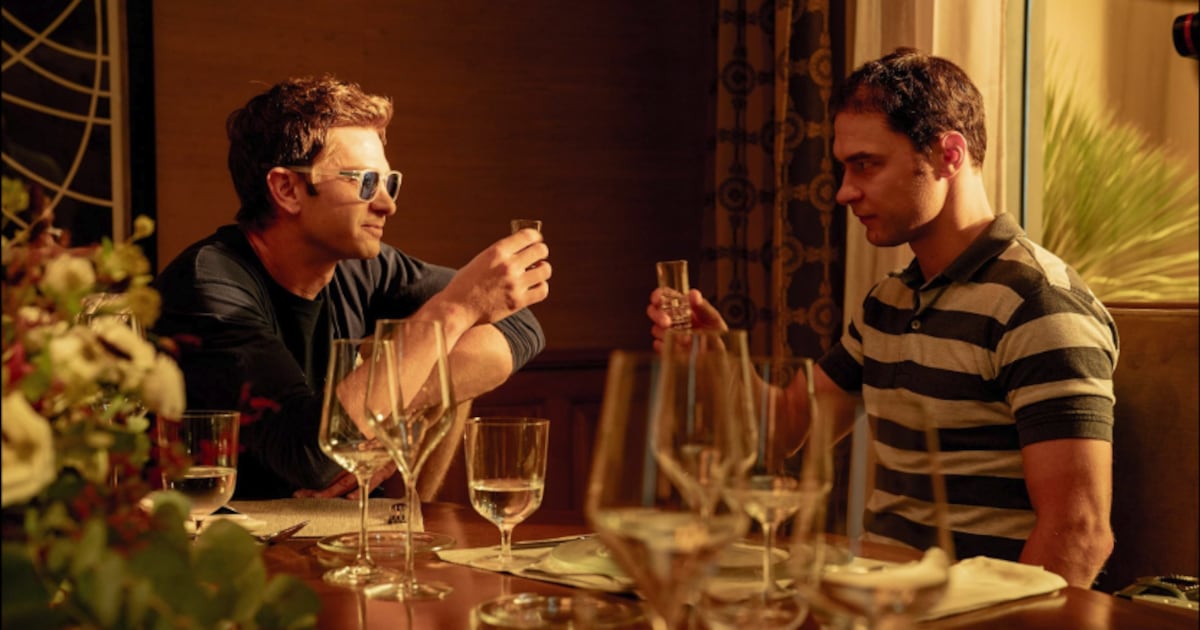
Sutskever thinks that the primary thing standing in the way of his goal is scaling—meaning, he needs more money to ramp up the amount of data he pumps into his A.I. Disregarding Hinton’s reservations, he solves this problem by partnering with Altman and Elon Musk (Ike Barinholtz), both of whom are won over by a big dinner speech in which Sutskever declares, “Feel the AGI!”
As Guadagnino’s camera pans around the table in the lead-up to that proclamation, Artificial captures the alluring promise of the technology and the borderline-religious faith that drives its development. Unfortunately, the spell the director casts breaks every time Musk appears on screen, thanks to a Barinholtz performance that consists of cartoonish faces and clownish gestures.
In large part because of the goofy Tesla CEO, Artificial’s tone is slightly off early on. It rights itself once Musk jumps ship on OpenAI because of its slow progress, which threatens to let its formidable competitors reach A.I. first. Garfield’s Altman is totally blasé about this abandonment, pivoting by bringing in (with Sutskever’s seal of approval) Mira Murati (Monica Barbaro). Along with board chairman Greg Brockman (Cooper Hoffman), the team sets out to change the world responsibly—a mission whose altruism the company’s nonprofit status supposedly safeguards.
Blur and Gorillaz frontman Damon Albam’s alternately electronic and orchestral score infuses Artificial with unsettlingly woozy energy, while Guadagnino and cinematographer Malik Hassan Sayeed’s canted angles give the film its edge, and their shot-counter-shot close-ups lend it an unnerving romanticism.
With the wind at their back, Sutskever and Altman head for the techno-horizon, but the former is so seduced by the latter’s charm and support—all of it wrapped in florid, soft-spoken encouragements and comforting reassurances—that by the time he realizes that his cohort is consolidating power, crassly monetizing their invention (via ChatGPT), and ignoring warning signs (including with regard to their deal with Microsoft), he’s left with nothing but dire options.
Astutely and amusingly written by the surrealist Saturday Night Live writer Simon Rich, Artificial moves efficiently through the recent past until it reaches its Big Bang: Sutskever convincing the board to fire Altman for deceptive and dangerous practices and to install Murati as OpenAI’s new CEO. This is the make-or-break moment for the company and, as Guadagnino’s film suggests, for the industry—if not the entire human race. As those acquainted with the news will know, Altman’s ouster was short-lived, and in the director’s hands, his proverbial resurrection plays out as depressingly inevitable, with only Sutskever unaware until the end that good intentions are no match (in Silicon Valley, or elsewhere) for unchecked greed and ego.
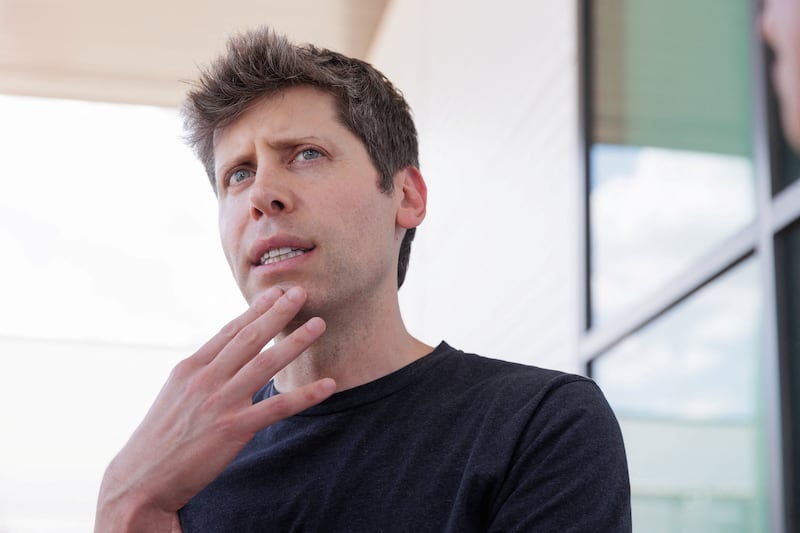
Garfield’s Altman is a weirdo who grows less human as his control over the planet’s most powerful tech increases, and Artificial is wise to not italicize that, as a manipulative and untrustworthy liar who only cares about his own survival, he’s the perfect reflection of his duplicitous A.I.. It’s Borisov, however, who’s truly magnetic as the principled Sutskever, who clings to the hope that safety and security will win out.
With a focused intensity that’s an extension of his character’s dogged inability to lie (making him the opposite of an AGI), the actor makes for a deeply sympathetic protagonist, not to mention a depressingly pitiable one once he’s forced to reckon with the nature of his allies and grapple with his own responsibility for the dawning A.I. crisis.
Guadagnino can occasionally be too flashy; a shot of Altman and Sutskever hugging in real time, with super-slow-motion background revelry, for example, is unnecessarily showy and distracting. And ultimately, his censure of the men hurtling the Earth toward possible destruction—without a care for anything other than their own narcissism and covetousness—is too familiar to radically open anyone’s eyes.
Yet Artificial imagines these tech pioneers in such bold and repugnant hues that it’s still easy to get swept up in Sutskever’s optimism and, consequently, to be wrecked by the rude awakening he receives. Consider it a caustic takedown of the stewards tasked with protecting us from the danger they’ve created, and a scary backstory for a future that looks bleaker with each passing day.