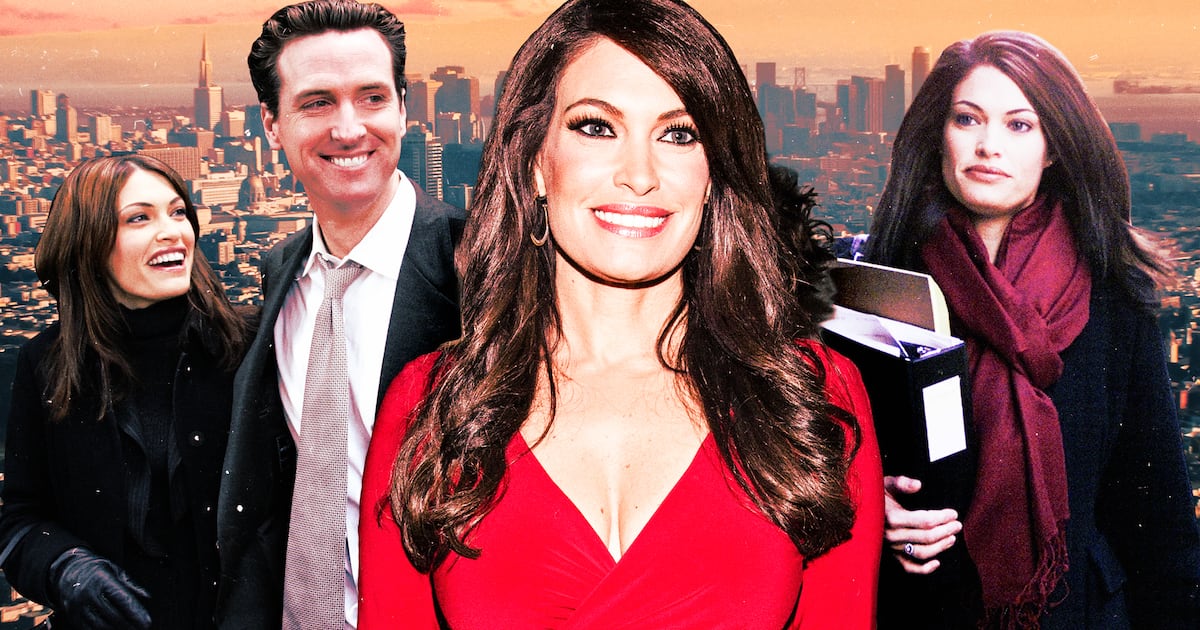

I’ve known Kimberly Guilfoyle longer than most people in the news business: We go back to the Bay Area in the 1990s, where we both went to law school and practiced criminal law, though on opposite sides of the bar. She was always a kind, if not the smartest, district attorney at the Hall of Justice.
I admired her scrappy ambition—Guilfoyle had worked as a lingerie model to pay her way through college and law school, and later married the handsome, ambitious Gavin Newsom. (At the time, Kimberly said she was ready to have Gavin’s children, calling herself “a very fertile Puerto Rican.” But she never would.)

She was already on the rise from local to national fame thanks to her prosecution of a San Francisco couple over the “dog-mauling death” of lacrosse coach Diane Whipple. The sensational case garnered nationwide attention—members of the Aryan Nation had bred the two Presa Canarios from prison as part of a dog-fighting ring; by the time they attacked Whipple, each weighed over 100 pounds—and though Guilfoyle had technically served as a second chair prosecutor, she walked away with most of the acclaim.

She subsequently turned up in New York City to host Both Sides on Court TV—she’d left everything, including Gavin, behind to move cross-country. (She called herself his “sugar mama,” which I found funny and, dare I say, feminist.) I was also at Court TV, and happy to see Kimberly; our San Francisco acquaintanceship morphed to friendship in the heady early days of our television careers. We shared a makeup artist and personal shopper. We stood together in stilettos on red carpets, and took town cars to and from events.

On one of those rides, she told me about losing her mother to leukemia as a child. This endeared her to me, but I didn’t fully appreciate the hole it had left in her life—and what the lack of a strong female role model in her childhood home might mean.

On another ride, she announced her intention to leave Gavin. I gave my unsolicited protestation—he was going places, could be president someday, she could be first lady. To her credit, Kimberly was introspective: “There is only room for one big ego in any marriage,” she explained. They were divorced soon after.
Kimberly left Court TV for Fox News in 2006. I became a frequent contributor there too, and so we remained friendly through her second marriage to businessman Eric Villency and the birth of their son, Ronan. But over the years we lost touch. From a distance, I worried she was changing. Her face, her personality, her politics.

We had our last solid conversation in 2009. I was wall-flowering at the Plaza Hotel when Guilfoyle, still radiant in Chanel and Manolo Blahniks, waved a manicured hand and approached from across the lobby. I braced myself, but there was no need: here was the same warm and charming Kimberly. She offered a hug, and we fell into our old give-and-take about TV news, mutual friends and, now, kids. I was pleased our mutual affection had survived her first wave of reinvention. But fame, money, and power are corrupting, and while I can’t pretend to know what was going on in her head and heart, I know what I’ve seen in the seventeen years since.


What happened? I’ve spent a lot of time thinking about it, more than most people, I’m guessing. As Fox News took hold of the political zeitgeist and Donald Trump took power, it seems she saw another opportunity for reincarnation. “The best is yet to come,” she infamously cackled at the 2020 Republican National Convention. But did she really believe it? Did she really believe in Trumpism? Has she ever believed in anything?
One Court TV incident that became network lore is more than entertaining; it reveals the depth of the problem—or the lack of it. The director, producers, and floor crew were all stunned when Kimberly began reading the anchor cues embedded in the script on air to viewers: “TURN TO CAMERA B,” “ROLL SOT,” and “TOSS TO REPORTER.” People have loved to tell this story over the years, but I thought it unkind—until I realize what it revealed: Guilfoyle’s talent was just reading a script rather than thinking about the content she was delivering.”

As her downfall has played out in recent days, fired by the Trump administration from an exile abroad after being abandoned by the Trump family, my phone has been flooded with messages from college friends and broadcast news colleagues alike, all wanting to dance on Guilfoyle’s grave. But despite all she has done to engender these feelings of schadenfreude among my left-leaning (and even some conservative) friends, I’m left feeling sorry for a woman who once had real promise. She remade herself in the image of others one time too many.
And somewhere along the way, she lost herself.